I’ve seen the incident several times and from many different angles. What happened seems clear to me: two cars are trying to pull out from an area Immigrations and Customs Enforcement (ICE) is operating in.
A silver SUV goes first, successfully exiting to the right. A burgundy Honda Pilot tries to exit left. It inches forward, but then a silver pickup truck approaches from the left. The driver tries to wave them forward to allow the truck to pass before attempting their own turn. Instead the pickup stops. ICE agents exit the vehicle and demand the occupants of the Pilot to do the same. Another agent recording with a cell phone comes from behind the Pilot, and walks to the front of the vehicle, trying to block its exit with his body. He switches his phone from his left hand to his right, apparently to free up his gun hand, before positioning himself in front of the vehicle.
The agent’s own video shows the same: at the beginning of the recording, he is on the driver’s side of the vehicle. He moves to the rear of the car and records the license plate. He moves to the passenger side and is insulted by Good’s wife. As his colleagues tell Good to get out of the car and try to open the door, he moves himself to the front of the vehicle to try to block her in.
This is a major violation of law enforcement protocol. For federal, state and local agencies alike, the standard operating procedure is to approach vehicles from the rear and side. Officers are supposed to remain behind the motorist at all times, to talk to them from the driver’s or (ideally) the passenger-side window. They are never supposed to block a vehicle with their bodies. Nor are they supposed to shoot at moving vehicles. Agents are not supposed to use firearms to disable vehicles or prevent suspects from fleeing unless the lives of themselves or others are at imminent risk. Law enforcement officers are discouraged from even chasing cars unless the criminal poses an immediate threat to the health and safety of others if they are allowed to escape. If someone is trying to get away and it’s possible to take their license plate number and track them down later, that’s what law enforcement is supposed to do. That’s what would’ve been appropriate in this case.
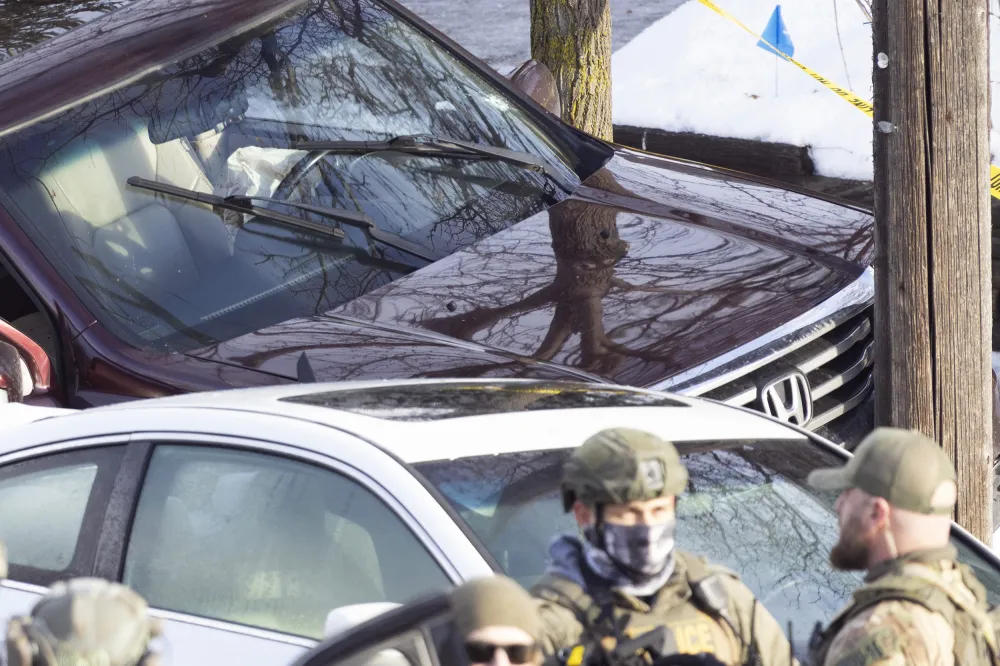
Instead of following these procedures, agents surround the car from the front and side before trying to force open the door. The driver seems to panic. The Pilot backs up a little before shifting to exit to the right like the previous vehicle did. At this point, the agent who had inappropriately positioned himself in front of the vehicle hops to the left and opens fire – shooting multiple times, once into the corner of the windshield, and subsequent shots at point blank range into the driver’s side window. With the steering wheel turned, and the now-dying driver with her uncontrolled foot on the gas, the car accelerates and completes the turn but then skids off to the side, hitting a white car.
The shooter casually walks away from the scene, apparently unharmed. The ICE agents do not attempt to provide aid to the injured person in their custody. A physician approaches the agents and offers to check her pulse and try to stabilize her if she’s alive. He is waved away. Other ICE agents are recorded having a jovial moment with the carnage right behind them. The driver’s wife is heard sobbing.
The person shot, Renee Nicole Good, is later declared dead. The 37-year-old mother of three had just moved to Minneapolis from Kansas City following a relationship change. This encounter with ICE agents happened shortly after she had dropped her youngest off at school in the morning. Good was a US citizen with no apparent criminal record (other than a few traffic stops). She has been described by her family as a devoted Christian who was kind to everyone she met. According to video footage of the event recorded by ICE agents themselves, her final words to the man who later shot her were, “I’m not mad at you.”
The shooter, Jonathan Ross, is a longtime border patrol and ICE agent who was injured in a separate altercation with a motorist last year. He’s an Iraq war veteran. His wife is a naturalized citizen from the Philippines. Like Good, he has been described by his family as a devout Christian.
Much more can be said about the organization Ross works for, and how changes at Immigration and Customs Enforcement likely contributed to the tragedy.
Under the Trump II administration, ICE agents have been allowed to operate without wearing uniforms or displaying their names and badge numbers. It has become standard for agents to carry out operations in unmarked vehicles and while wearing masks. Federal agents have been permitted to detain virtually anyone – without a warrant or conventional probable cause. This has led to many US citizens being unjustly harassed, detained or assaulted by ICE agents.
These shifts have allowed criminals to engage in robberies, kidnappings and sexual assaults by pretending to be ICE agents as well. Literally anyone could say that they’re with ICE and demand virtually anything from anyone upon penalty of violence, and there’s no way for most citizens to discern whether or not this is a lawful order from an actual agent. These changes undermine public safety and public order by granting law enforcement and criminals alike a sense of impunity at the expense of ordinary citizens.
In the months leading up to this incident, Immigrations and Customs Enforcement had also significantly reduced their vetting, training and standards in order to meet the Trump Administration’s ambitious recruiting goals. Many have been hired who would not have passed muster under previous administrations – and these hires have been given less training and oversight than previous cohorts of ICE agents. This may have played into the chaos that cost Renee Good her life. As one eyewitness put it:
“Some of [the demonstrators] were leaving, and they just went around her, but ICE gave [Good] orders to leave, while at the same time, another ICE person said, ‘Get out of the car,’ and he reached for her door handle. And then there was an ICE agent in front of her vehicle. So it was difficult for her to leave, as she’d been ordered to do.”
Given conflicting orders, perhaps by novice officers with insufficient preparation and supervision, it would have been difficult for the situation to have avoided escalating regardless of what Renee did in that moment.
Adding fuel to the fire is the reality that, in addition to reducing requirements and eliminating safeguards, the deployment of ICE agents had grown more explicitly political. The Trump Administration has been unabashed about deploying federal forces – from the National Guard to ICE – to cities run by his political opponents. These forces are not just being deployed in nakedly partisan ways, they are increasingly being recruited based on ideological and cultural affinity with the GOP. ICE is cultivating people who may be eager to exercise coercive power over liberals and leftists, and they being deployed overtly for that purpose.
Simultaneously, the Trump Administration has been paying right-aligned influencers to spin ICE and its actions in a positive light – and they have descended on Minneapolis in force to produce and amplify partisan narratives on behalf of the White House.
Meanwhile, more conventional right aligned media have attempted to justify Renee’s killing by painting her as the kind of person that, to their mind, isn’t worth mourning over: an activist, a liberal, a “self-proclaimed poet,” a lesbian, and so on.
In short, both the agency itself, and narratives about the agency and its actions, have grown increasingly partisan.
This confluence of growing politicization, heightened impunity, and lowered standards in Immigrations and Custom Enforcement provide fertile soil from whence tragedies like this can sprout. And it deserves to be stressed: Renee Good’s death was not an isolated incident. 2025 was one of the deadliest years on record for people detained by ICE. This year is now off to an ominous start too.
That’s my read on the situation. I take some comfort in the fact that a majority of Americans seem to have arrived at a similar set of conclusions, as revealed in a recent YouGov poll.
| Question | Share of respondents with a particular answer |
| How much have you heard about an ICE agent recently shooting and killing a 37-year-old woman while she was in her car in Minneapolis? | 67%: A lot |
| Have you seen any video footage of the ICE agent shooting the woman in Minneapolis? | 70%: Yes |
| Do you think the ICE agent was justified or not justified in the amount of force he used in shooting the woman in Minneapolis? | 53%: Not justified |
| Do you think the ICE agent should face criminal charges for shooting the woman in Minneapolis? | 53%:Yes |
| What comes closest to your view on people who are killed by ICE agents or in ICE custody? | 56%: These deaths show there is a fundamental problem with ICE that needs to be fixed |
| How would you describe the tactics currently used by ICE? | 53%: Too forceful |
| Do you think ICE officers should be required to wear uniforms when making arrests? | 69%: Yes |
| Do you think ICE officers should be allowed to wear masks when making arrests? | 55%: No |
| Do you think ICE agents should be able to enter K-12 school campuses? | 64%: No |
| If a state’s governor calls on ICE agents to leave an area where they are conducting operations, should they leave? | 59%: Yes |
When you look at net favorability (subtracting the percent who support a proposition/ actor from the percentage who oppose it—with positive numbers indicating more overall support than opposition, a negative numbers signaling the opposite), there is substantial support for restraining and cutting back ICE:
| NET POSITIVE PROPOSITIONS | |
| Stricter recruitment requirements for ICE agents? | 51% |
| Prosecute ICE agents who kill people | 29% |
| Reduce ICE’s size and funding | 11% |
| NET NEGATIVE PROPOSITIONS | |
| A favorable view of ICE | -12% |
| Keep ICE in it’s current form | -12% |
| Expand ICE’s size and funding | -14% |
| Loosen recruiting requirements so ICE can hire new agents faster | -41% |
Support for the protests against ICE are more mixed (49% approve, 41% disapprove, the remainder are unsure) – but this net positive rating is itself a sign of the times. The American public generally disapproves of any protest movement while it is happening (although they often come around in retrospect), and six months ago anti-ICE protests were clearly underwater in the polls.
In short, my personal perspective on both this particular incident and ICE more broadly seem to be shared by growing pluralities or majorities of the public.
But of course, there are others who subscribe to alternative views.
The White House Account of Renee Good’s Death
According to President Trump, Good was driving the car in disorderly way while simultaneously attempting to “violently, willfully and viciously” run over an ICE officer – a brave agent who barely made it out with his life. He largely stuck to this characterization when pressed by reporters on videos that have subsequently emerged that seem to undermine his claims.
Vice President Vance described it as a “lie” that Good was “some innocent woman” gunned down by federal agents, insisting evidence-free that she was “part of a broader left-wing network.” He then softened his tone – expressing regret at her passing and conceding that, despite how he’d just characterized her, Renee may not have intended harm to the agent who shot her.
Homeland Security Secretary Kristi Noem, on the other hand, insisted that Good “attacked the agents and those surrounding them” by attempting “to run them over and ram them with her vehicle” in an “act of domestic terrorism.”
Here, Noam is parroting earlier statements by federal officials who described ICE’s “targeted operations” as being blocked by “rioters,” one of whom “weaponized her vehicle, attempting to run over law enforcement officers in an attempt to kill them.”
It should be emphasized that this line is pulled straight out of a playbook. Law enforcement officials regularly justify shooting unarmed people by attempting to portray motorists’ vehicles as weapons and claiming the officers feared for their lives. They rely on this narrative because juries are unlikely to convict officers who claim to have faced mortal fear – even if they brought the risk upon themselves by violating standard operating procedures (as happened in this case: Ross put himself in a risky situation and then shot Good on the grounds that he felt scared).
But it seems as though a jury will never get to try this case at all. Administration officials have declared that there will be no investigation into wrongdoing. Instead, they will be investigating Good’s family and friends, and local political leaders who criticized ICE. As Radly Balko put it,
“It’s one thing to tank or slow-walk an investigation. It’s quite another to publicly declare that no investigation will happen on any level and then announce that you’ll be investigating the victim’s partner and supporters instead. Both paths are unethical and corrupt. Undermining an investigation at least pays lip service to the idea of accountability and public trust. The administration’s actions in Ms. Good’s case are a declaration that there will be no accountability and that it would prefer to instill fear rather than trust.”
Despite the extraordinary nature of the White House response, polling suggests that roughly one third over Americans support the Trump Administration’s interpretation of the incident. Another 10-15 percent are unsure what to believe. The ever-proliferating videographic evidence may be relevant for the small minority who haven’t yet made up their mind, but it’s unlikely to shift anyone who’s already in one camp to another.
Moving Beyond Futile Debates About What the Footage Shows
Most who try to bolster the Trump Administration’s narrative that the officer was struck by the vehicle and, therefore, responded in self-defense have focused on one particular shot – recorded from a distance and at an awkward angle – that seems to show the ICE agent slapping the hood of Good’s car as he pivoted to the drivers side. Many fixate on this clip, shared by President Trump, to the exclusion of the other videos described (and linked to) above.
In other cases, however, people have watched the exact same videos that led me to my interpretation of what happened but still arrive at the conclusion that Good was trying to ram the officer and he responded with reasonable force to a life-threatening situation.
This happens because our cognitive and perceptual systems – both others’ and my own — do not perceive the world in an objective, disinterested and comprehensive fashion. Instead, we’re wired to process reality selectively and in ways that advance our interests, further our goals or affirm our preexisting view of the world.
With respect to people’s interpretation of protests, studies have found that you can present people with images or video of a protest and their opinions of whether the demonstrations are peaceful and lawful or dangerous and illegal turns tightly on whether or not the demonstrators are perceived to be their ideological or political allies. If you tell conservatives that the demonstrations are pro-life, they view them as kosher. If you present the same videos but describe them as examples of BLM protests, they arrive at the opposite conclusions. And the same holds for liberals in reverse.
For videos of interactions with law enforcement officials, scholars have found that antecedent support or skepticism towards law enforcement tightly predicts whether viewers believe law enforcement acted properly or not, whether they view any use of force was justified or not, and whether or not they think officers should be punished as a result of the interaction. The video doesn’t seem to shape people’s perceptions of an incident so much as their preexisting beliefs shape their interpretations of the video.
These tendencies are not just evident among laypeople. Research consistently finds that you can task different scientists with answering the same question using the same data and methods, and they’ll arrive at wildly divergent results based on what they wanted or expected to find. It’s impossible to just “follow the data” to objective truths because every step of producing, analyzing and presenting data is informed by decisions of researchers. And when they’re investigating a contentious issue or something with strong moral, legal, financial or political implications, the decisions researchers make tend to be strongly informed by what would be most expedient to find.
The same cognitive tendencies that lead scientists to interpret the same empirical evidence in radically divergent ways likewise allow members of the public to look at the same incident footage and draw incommensurate conclusions.
I am confident in my view of what happened on that street, and I happen to be aligned with the majority view. But many on the other side of these discussions who have watched the same footage are also confident in their understanding of events. We’re unlikely to persuade one another, no matter how long we go back and forth.
One could proliferate hundreds of videos of the incident from dozens of different angles and, if anything, this would only heighten polarization further by creating more potential avenues for people to reinforce their antecedent views by focusing on specific details, ignoring others, and interpreting ambiguities in a manner that aligns with their interests, values and priors.
We’re unlikely to reach agreement about what these videos show because what stakeholders are ultimately arguing about isn’t what happened to Renee Good, specifically. We’re arguing about whether President Trump’s immigration crackdown is necessary, legal, or being carried out well. We’re arguing about the proper relationship of law enforcement to the publics they serve. We’re arguing about how to manage tradeoffs between goods like liberty and order. More fundamentally, we’re arguing about violence, coercion and expropriation: who gets to enact these, against whom, under what conditions, and towards which ends. The best picture we have from the cognitive and behavioral sciences is that it would probably be more honest, productive and revelatory to talk about these “big” questions that ultimately drive differing interpretations of what happened on that Minnesota street than to quibble ad infinitum over different videos and what they reveal (or don’t).
It will ultimately be for Immigration and Customs Enforcement’s chain of command and, God willing, a judge and jury to determine professional and legal culpability for Renee Good’s death (and again, the administration has signaled an intent to outright abdicate that duty). Practically speaking, others’ personal interpretations of the incident are inconsequential. But as citizens of a democracy, all of us do have a say about the type of society we want to live in. That should be where we direct our focus – not just for Renee, but also for the loved ones she leaves behind, and our own loved ones, and indeed, for ourselves.