The need for Heterodox Academy is not due to contemporary ideologies or developments. it instead arises out of fundamental aspects of human information processing that are often exacerbated by how many knowledge producing institutions are organized.
The following resource connects readers with peer-reviewed empirical studies elaborating on the challenges Heterodox Academy was formed to help address (click to expand).
Human beings’ cognitive capacities are capable of extraordinary feats. However, they’re also fundamentally oriented towards tribalistic and self-interested reasoning.
Enlightenment era scholars, and many classical scholars before them, believed that human cognition was fundamentally oriented towards truth, objectivity and logic. Deviations from this ideal were held to be caused by forces external to our minds, such as our physical appetites, social corruption, or malevolent supernatural entities. The contemporary scientific consensus is now oriented around a completely different understanding of rationality.
For instance, contrary to earlier conceptions of cognition juxtaposing the body and mind, it’s now understood that we always think with and through our physical bodies, and there isn’t any way around it.
However, thinking is not something that occurs exclusively within our individual heads – it occurs primarily in conjunction with others, in dialogue with our physical and social surroundings, and with the use of human-produced tools and resources alongside other cultural artifacts. At a fundamental level, we think with and through other people and our environments in much the same way as we think with and through our physical bodies.
Indeed, our rational capacities seem to have been developed largely in response to social pressures – to mitigate practical issues related to living in collaborative groups – such as:
- Persuading others to do what we want or need them to do
- Avoiding getting manipulated by others in adverse ways
- Maintaining or enhancing the standing of ourselves and the groups we identify with relative to “others”
Over time, the extraordinary capacities we developed to address these types of social coordination challenges developed into two distinct but interrelated cognitive systems.
One system specializes in dealing with immediate, routine and necessary tasks and dilemmas. It works rapidly, automatically, and largely unconsciously – drawing on and producing tacit knowledge.
The other system is designed to deal with more difficult, novel, and high-stakes challenges. It is more deliberative. It is the system of our conscious thought. Its outputs are more easily translated into words to be conveyed to others.
This latter cognitive system is what people are generally referring to when they talk about “thinking” or “rationality.” However, the former system actually drives most of our understanding of, and response to, the world – and informs much of our conscious thought. As social psychologist Jon Haidt emphasized:
“The mind is divided into parts, like a rider (controlled processes) on an elephant (automatic processes). The rider evolved to serve the elephant… Human minds, like animal minds, are constantly reacting intuitively to everything they perceive, and basing their responses on those reactions. Within the first second of seeing, hearing or meeting another person, the elephant has already begun to lean toward or away, and that lean influences what you think and do next. Intuitions come first.”
These general characteristics of human cognition shape everything people do – including scientific research and adjacent pursuits.
On the one hand, our socially-evolved brains are capable of remarkable feats. Working and thinking together, we’ve developed means of travelling into space. We can split atoms. We can communicate instantaneously across continents. We can prevent people from contracting diseases like leprosy and polio that have long ravaged humankind.
However, at the individual level, our ability to understand the world is inevitably constrained in some highly-consequential ways. Consider the process of perception:
At all times, we are bombarded with stimuli. In a lecture hall, for instance, a professor could pay attention to how many students seem to be right-handed versus left handed, how many ceiling or floor tiles there are in the room, what ratio of students are wearing corrective lenses, and so on, ad infinitum. It’s impossible to attend to all the information that is available to us at any given time – and that’s fine, because most of it isn’t particularly valuable anyway.
And of the things we do pay attention to, we can’t remember everything we notice indefinitely – and it wouldn’t avail us much if we could.
Instead, we have to make decisions about what to focus on, and what to retain (this is called “selection”). We have to organize the details we observe into a relatively stable and coherent picture – often making determinations about how events and phenomena relate to one-another (this is called “organization”). And then we have to make inferences about what it all means, what the significance of the observed phenomena are, and how we should respond to the things we observe (this is called “interpretation”). This process unfolds instantaneously and largely unconsciously. And for good reason:
In the real world, we can’t sit and ruminate indefinitely. Decisions must be made about what to focus on, what to remember, how it all fits together, if and why things matter, if and how we should act, and so forth. We typically need to make these determinations quickly, with limited information, in dynamic conditions, with high degrees of ambiguity and uncertainty. Trying to gather more and more information, contemplating things over and over without acting – this can have high opportunity costs and often leads to worse decisions in any event. Under most conditions, our intuitive cognitive systems are reliable, quick and highly efficient.
However, the decisions we make about what to focus on (or not), what we remember and how we remember it (or don’t), and how to interpret ambiguous signals – these choices are not made in a random or disinterested way. Our brains are not designed to produce an “objective” and “true” picture of the world. Instead, reflecting their social origins, our cognitive capacities are oriented towards perceiving, interpreting and describing reality in ways that enhance our fitness and further our goals – often generating a distorted understanding of the world around us in the process.
We pay attention to, easily recall, and feel positive emotions towards things we deem interesting or useful. We dismiss, downplay, dump, and have negative emotional reactions to information that is threatening to our objectives or our self-image, or that conflicts with our expectations or pre-existing beliefs. Things that don’t seem particularly significant in either direction, we largely ignore (even though sometimes these neglected details prove to be quite important).
These types of systematic distortions are known as “biases.” They’re tied to the core information problems we have to solve in light of our cognitive and perceptual limitations (and our need to act in the world despite them):
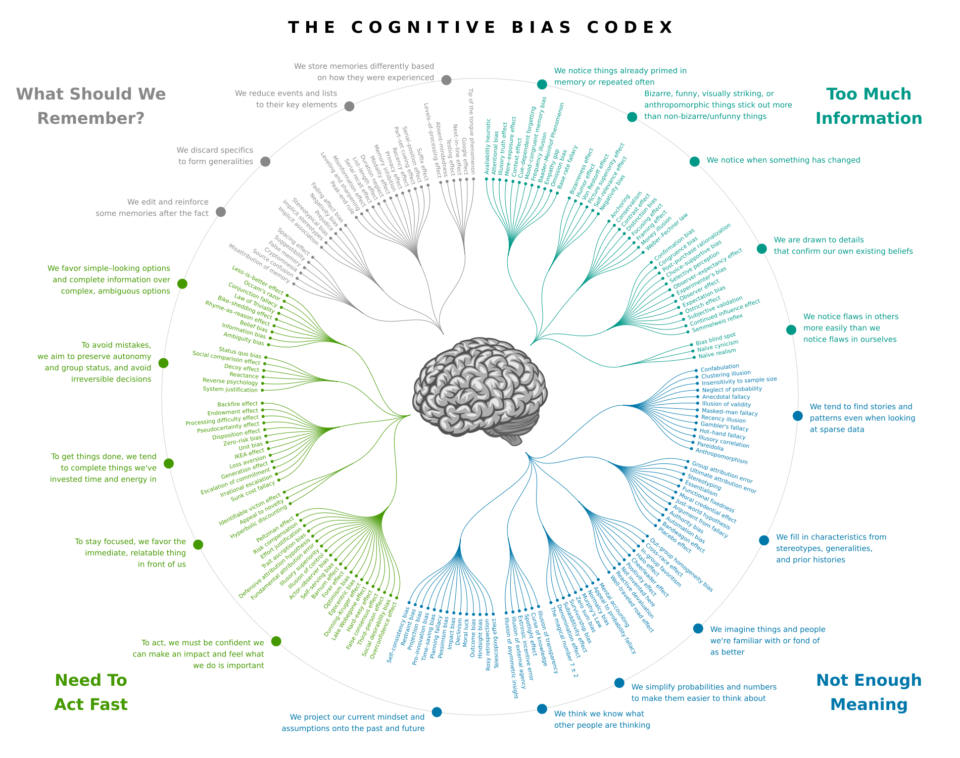

Critically, it isn’t just our perception that’s biased. Our attributions (the causal stories we tell about why things are the way they are, why things happen the way they do, and so on) operate in a similar way.
When good things happen that could be plausibly laid at our feet, we attribute those positive outcomes to stable and internal factors that are within our control – i.e. positive characteristics we possess and wise actions we took. When bad things happen, we tell the opposite story: the outcomes are due to contingent and fleeting circumstances – things external to us and outside of our control. We don’t just tell these systematically skewed stories for ourselves, but also for groups, movements and institutions we identify with. And for folks we disidentify with, the dynamics are reversed: we attribute good outcomes to luck, privilege, fleeting circumstances, and so on – and we attribute bad outcomes to durable characteristics and willful actions.
In fact, most cognitive biases can be boiled down to a handful of self-serving assumptions like these:
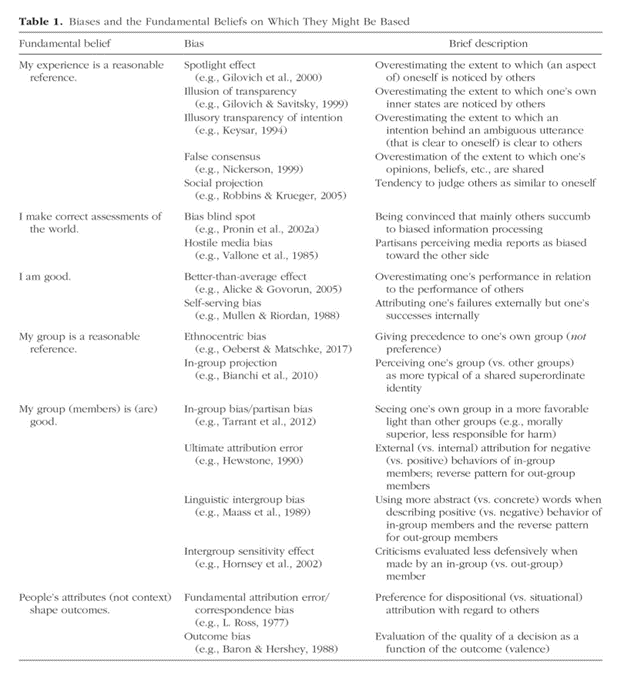
Again, these aren’t just tendencies that people have in their daily lives, but that we somehow set aside when operating as scholars. The inclination towards tribalism, status seeking, identity reinforcement and other forms of motivated reasoning may be, in fact, the main purpose of our cognitive faculties – it’s the thing they’re best at, and it influences everything else they do. They clearly inform academic knowledge production — especially with respect to morally or politically contentious issues – as well as committee-based hiring and promotion decisions.
In principle, these well-documented and ubiquitous cognitive tendencies should inspire a sense of intellectual humility in scientists – a deep awareness of our own fallibility and limits. In practice, however, people tend to think of themselves as exceptions to general rules.
People typically think of themselves as smarter, more moral, and less biased than most others. We tend to think that the forces that bind and blind everyone else do not govern our own attitudes and behaviors to the same extent, if at all. Other people (especially those we don’t identify with) are driven by self-interest, ideology, and so on. We are motivated by strong ethical standards, including a principled commitment to the truth.
Sociologist Andrew Abbot referred to this as “knowledge alienation”: declining to apply information we have about the world to ourselves and the institutions and groups we identify with.
Indeed, even when people intellectually recognize that we are susceptible to bias and error, and that we’re working from limited knowledge and experiences (and other people might have important information that reveals our own commitments to be erroneous) – it’s hard for us to actually feel that way, especially in moments of contestation. This is because, with respect to many cognitive distortions, our brains seem designed to avoid recognizing our biases. We have “bias blind spots” that interfere with our ability to recognize when our cognition is going astray.
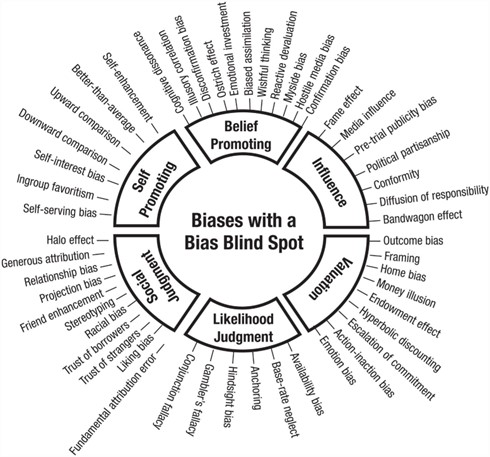
It should be emphasized again that we these cognitive tendencies are not necessarily pathological. In general, our biases and heuristics allow us to process and respond to extraordinary amounts of information quite quickly in dynamic circumstances. We could scarcely function without these distortions. Even bracketing the cognitive and perceptual limitations and constraints we have to work within – if we truly saw the world as it actually was, if we saw ourselves and our loved ones as they actually are, if they saw us as we truly are… that would be unlikely to make us happy.
Likewise, if our actions were tightly calibrated to the statistical likelihood of success of our ventures, there are many risks we wouldn’t take (that we currently do take), and we’d miss out on a lot in life as a result. Most business fail within six years. An overwhelming majority of romantic relationships end in less than a year. Most employment relationships end up not working out for one or more parties eventually (relative to the alternatives) – typically leading to resignations or termination within five years. Social movements rarely achieve their stated ends. Most innovations are maladaptive. The modal result of publication submissions is rejection. An overwhelming majority of published scientific findings are wrong, trivial, and/or non-impactful. If we allowed these types of probabilities to govern our attitudes and behaviors, we’d rarely invest ourselves in anything.
In reality, however, people defy the odds all the time. Ostensibly irrational levels of confidence, conviction, resilience and optimism often play an important role in these outcomes. Our biases and blindspots are, therefore, not just a product of our cognitive limitations – they empower us to accomplish things we otherwise may not. In Nietzschean terms, our cognitive distortions serve important life-enhancing functions.
That said, it is also an indisputable empirical fact that biases and limitations to our perceptions, experience and cognition often do cause practical problems – especially with respect to knowledge production, and particularly when it comes to contentious social topics. Our socially-oriented cognition (seeking status, tribal victories, and the like) often supervenes even sincere attempts to pursue the truth wherever it leads.
Because these tensions arise from fundamental aspects of our cognition, the resultant problems must be actively and perennially managed. Bias, the exclusion of outgroups and the suppression of inconvenient findings are not new issues. Research on how these tendencies influence knowledge production goes back more than a century – as do organizational efforts to mitigate these challenges.
Put another way, the problems HxA is working to help academics overcome are not novel products of “kids these days,” “wokeness,” or adjacent contemporary developments. They are problems related to human nature. They will endure as long as modern science does because, in a deep sense, what we are trying to do as scientists is unnatural.
Our natural impulses are to sort into groups with people who share our values, politics, and other identity commitments, to publicly bring ourselves and push others into conformity with the group, and try to suppress, exclude or dominate others with incompatible goals and perspectives. Our default inclination is to perceive and interpret the world in ways that flatter our self-image, advance our interests and reinforce our existing worldviews – while explaining others’ deviance from our preferred positions through appeals to deficits and pathologies.
It is not natural to work with people along lines of difference, making decisions about things like admissions, hiring and promotion purely on the basis of merit. It is not natural – and in fact, it is very difficult (but also quite important) – to recognize and publicly acknowledge our error, and then revise our attitudes, beliefs and actions in accordance with the best available evidence – irrespective of our own expectations, interests and preferences.
Contrary to Enlightenment era conceptions, our individual brains are not oriented to follow the truth wherever it leads and perceive the world in a comprehensive and objective fashion. The good news is, the same social features of our cognition that lead us astray at the individual level also enable us to transcend our personal limitations. Working with stakeholders whose experiences, commitments, interests and skills diverge from our own, and with the right institutional structures and incentives, we are capable of intellectual feats that we would never be able to achieve independently. Cognition is better together. And great minds don’t always think alike.
Cognitive sophistication and specialized knowledge don’t eliminate biased reasoning. In fact, scholars may be especially prone to extremism, dogmatism and certain cognitive distortions as compared to ordinary folks.
People typically think their beliefs are correct – morally, factually, and otherwise. We further assume that we arrived at our beliefs in a good way – we think the things we think for good reasons. We view our own experience is a good guide to how the world works. We perceive ourselves to be personally representative of the groups and institutions we identify with.
As a corollary of these assumptions, when we encounter others who hold beliefs that are incompatible with our own, we don’t start by questioning our own views (and the means by which we arrived at them). Instead, we try to figure out what’s wrong with “those people” who disagree with us. Our first (and typically dominant) instinct is to explain deviance from our own views by appeal to deficits (ignorance, irrationality, a lack of cognitive sophistication, inexperience) and pathologies (“those people” are bigots, zealots, authoritarians, and so on).
These are general human tendencies. Scholars, as humans, are prone to these same manners of thinking. And this poses a significant challenge for research and teaching – especially on highly-charged moral and political topics.
Here, a discerning reader might object that, while it’s certainly true that scholars are people, we’re not exactly normal people. For instance, we have far more knowledge about various topics than the average person (especially with respect to our areas of expertise). We’re cognitively sophisticated (i.e. we perform highly on assessments of intellectual ability). We’re highly conscientious (allowing us to maintain high GPAs throughout our educational careers and, ultimately, to see our credentials through to completion). We define ourselves in terms of our commitment to following the truth wherever it leads and acting in accordance with the best information. Surely, these must influence our susceptibility to bias and motivated reasoning, right?
Fortunately, we don’t have to speculate on this matter. There is a robust literature on the political psychology and cognition of people with high IQ scores, high GPAs, and high levels of education – i.e. the type of people who are most likely to become academics. It turns out, the kinds of people who comprise the academy do tend to vary systematically from most other people . . . albeit not in the ways we like to think.
For instance, people who are highly educated, intelligent, or rhetorically skilled are significantly less likely than most others to revise their beliefs or adjust their behaviors when confronted with evidence or arguments that contradict their preferred narratives or preexisting beliefs. Precisely in virtue of knowing more about the world or being better at arguing, we are better equipped to punch holes in data or narratives that undermine our priors, come up with excuses to “stick to our guns” irrespective of the facts, or else interpret threatening information in a way that flatters our existing worldview. And we typically do just that.
In a decades-long set of ambitious experiments and forecasting tournaments, psychologist Philip Tetlock has demonstrated that—as a result of their inclinations toward epistemic arrogance and ideological rigidity—experts are often worse than laymen at anticipating how events are likely to play out . . . especially with respect to their areas of expertise. Likewise, experts have been shown to perform a bit worse than laymen at predicting the likely effects of behavioral science interventions. Comparative and longitudinal studies have found that highly educated political leaders perform no better than less educated ones, and may even be a bit worse in some respects.
Patterns like these are difficult for many academics to anticipate because we often operate under the assumption that our cognitive and perceptual systems are fundamentally oriented towards accuracy – and therefore people with more refined intellectual capacities should enjoy a privileged access to the Truth. In reality, however, humans’ mental capacities seem to have evolved in large part to help us cooperate with in-group members in competition against “others” [INSERT LINK TO FIRST ESSAY IN THE SERIES]. That is, our cognitive capacities are fundamentally geared toward group building and coalitional struggles. We tend to reason in ways that help us achieve our goals with and through other people.
On this understanding of how our brains work, we might expect that the kinds of people the professoriate selects for (cognitively sophisticated, academically high-performing, highly educated) may be especially prone to tribalism, virtue signaling and self-deception. And, unfortunately, there is a lot of empirical evidence that seems to pull in this direction.
For instance, rather than becoming more likely to converge on the same position, people tend to grow more politically polarized on contentious topics as their knowledge, numeracy, reflectiveness increases, or when they try to think in actively openminded ways.
Highly educated Americans are also much more likely than others to know what positions they “should” hold in virtue of their partisan or ideological identities, and we’re more likely to align our beliefs to systematically accord with those identities. We are more likely to form positions on issues we didn’t previously have strong opinions about by looking to partisan cues—and to modify our existing positions to bring them into line with new messaging from party leaders. Politically sophisticated Americans are also more likely to systematically accord their political beliefs and preferences to their religion, race, gender, or sexuality—conforming themselves with what they “should” think or say on the basis of their identity characteristics (while other in-group peers tend to have much more heterogeneous sets of views and dispositions).
That is, in a literal sense, the kinds of people who comprise the professoriate strive to be “politically correct” in their views much more than other Americans. It should therefore not be surprising that college-educated Americans are more likely than other Americans to self-censor. Nor should it be shocking to discover that censorship of science is heavily driven by scientists themselves, typically against people whose moral and political views diverge from scientists’ own.
With respect to political engagement, highly educated voters are much more likely than most others to donate to political causes. They’re also more likely to have flexible work schedules that facilitate their higher rates of voting, protesting, and other political activities. Yet, although these constituents tend to be more politically engaged on average, their political involvement is also much less likely to be oriented toward pragmatic ends. Instead, Americans with high levels of education gravitate toward “political hobbyism” and “expressive voting”—that is, engaging in political research, discourse, and other activities for the purposes of self-aggrandizement, entertainment, validation of one’s identity, and so forth instead of trying to realize concrete and practical goals.
In virtue of these tendencies, highly educated people tend to follow political horse races much more closely than the general public, and are often much better versed in contemporary political gossip, drama, or scandals. Yet we tend to be little more informed than most with respect to more substantive facts—often lacking even rudimentary knowledge about core civic institutions and processes. And the more we think we know, the less self-aware we tend to become with respect to our own biases and ignorance. As social psychologist Keith Stanovich put it, “If you are a person of high intelligence, if you are highly educated, and if you are strongly committed to an ideological viewpoint, you will be highly likely to think you have thought your way to your viewpoint. And you will be even less likely than the average person to realize that you have derived your beliefs from the social groups you belong to and because they fit with your temperament and your innate psychological propensities.”
Indeed, education and cognitive sophistication themselves seem to increasingly serve as bases for tribalism. Highly educated people tend to marry and socialize with others possessing similar levels of education as themselves. Even among the highly educated, those with high levels of academic performance tend to cluster together—and gradually abandon social ties with those of lower GPAs. And with respect to engaging with “others,” college graduates often look down on those with fewer (or worse) credentials than themselves.
One series of studies looking at college grads in the United States and western European countries found that people who graduated from college viewed less educated people more unfavorably than they did any other reference group. They were also less supportive of programs to help less educated people compared to other potential recipients. And while they often expressed some sense of shame or regret for prejudices expressed against other groups, they were unabashed in their bias against those less educated than themselves. In light of the ways educational attainment varies systematically along the lines of race, gender, and class, these forms of education-based prejudice often exacerbate and reinforce other forms of bias and discrimination.
Likewise, although highly educated and cognitively sophisticated Americans are less likely to express racially prejudicial attitudes on surveys, we tend to be far more prejudicial than most against those whose ideological views diverge from our own. We are also much more prone to overreact to small shocks, challenges, or slights. Much like biases against less educated people, these ideologically-based tendencies towards discrimination and censorship most adversely impact people whose position in higher education institutions is already marginal.
Even the apparent racial and ethnic tolerance that highly-educated voters exhibit may be a function of the fact that, precisely in virtue of being more elite than other Americans, academics’ material interests, ambitions, and life prospects do not appear to be threatened by people from historically marginalized and disadvantaged groups. Research has found that when highly educated people do come to sense that their own interests or prospects are undermined or threatened by competition with racial or ethnic minorities, they often become significantly more hostile toward the groups in question despite their previous egalitarian leanings.
More generally, although cognitively sophisticated people are more likely than most to endorse racial equality in principle, they seem to be no more likely than others to support policies that would undermine relative advantages they personally enjoy—and their cognitive sophistication is part of what may allow them to justify this gap to themselves and others. High levels of creativity have likewise been found to be connected with higher levels of unethical behavior—in part because highly creative individuals excel at rationalizing harmful actions to others and themselves, and tend to think of themselves as exceptions to rules that others have to play by.
In part as a consequence of our ability to produce rationalizations of this nature, highly educated Americans tend to be less aware of our own sociopolitical preferences than most—typically describing ourselves as more left-wing than we actually seem to be. Studies consistently find that highly educated and cognitively sophisticated voters tend to gravitate toward a marriage of cultural liberalism and economic conservativism. However, we regularly understand ourselves as down-the-line leftists. As economist James Rockey put it, “How does education affect ideology? It would seem that the better educated, if anything, are less accurate in how they perceive their ideology. Higher levels of education are associated with being less likely to believe oneself to be right-wing, whilst simultaneously associated with being in favour of increased inequality.”
In addition to our poor self-awareness with respect to how committed to egalitarianism we actually are, highly educated Americans tend to be much worse at gauging other people too—typically assuming others are more extreme or dogmatic than they actually seem to be. This is perhaps a product of the reality that, as compared with the general public, the kinds of people who become academics (highly educated, cognitively sophisticated, academically high performing) tend to themselves be more ideological in their thinking, more dogmatic in their views, and more extreme in their ideological leanings than everybody else—and the process of attaining a college education seems to drive people even further in the direction of moral absolutism. A recent National Bureau of Economic Research study found that the Americans most prone to zero-sum thinking included people who lived in cities, those who have especially low or high levels of income, people who identify as strong Democrats (academics identify with Democrats at a ratio of 5:1), and those who possess postgraduate degrees.
In short, far from being independent thinkers who come to their positions on issues through a careful deliberation of “the facts,” who change their minds readily in accordance with “the facts,” and who make wise decisions by deferring to “the facts,” the kinds of people most likely to become academics (highly-educated, academically high-performing, cognitive sophisticated) are more likely than most to be dogmatic ideologues or partisan conformists. Yet it is difficult for us to recognize these tendencies in ourselves due to our larger “bias blind spots” and increased capabilities for motivated reasoning.
Put another way, the need for organizations like Heterodox Academy is particularly acute in places like colleges and universities precisely because these are institutions with especially high concentrations of smart and knowledgeable people. Subject-matter expertise and cognitive sophistication doesn’t allow folks to overcome the general human tendencies towards bias and motivated reasoning. If anything, it makes it harder.