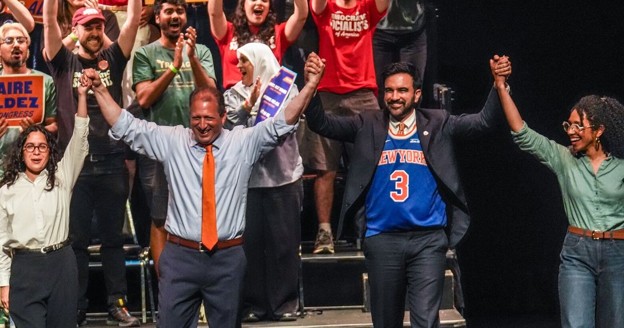
In the June 23 NYC Democratic primary elections, recently-elected mayor Zohran Mamdani pulled off a series of coups. He put forward a slate of allies who defeated three candidates favored by New York governor Kathy Hochul, Senate Minority Leader Chuck Schumer and House Minority Leader Hakeem Jeffries – including two incumbent politicians.
A lot of ink has already been spilled on how he accomplished this task. One thing that has been underrecognized is the extent to which he secured his victory on Tuesday by adopting a strategy that was in many ways the opposite of what he did to win his mayoral victory last year.
In the 2025 general election, Mamdani had to appeal to a wide range of moderate, independent, swing and undecided voters because he was competing not just against a Republican challenger, but a well-funded third-party challenger. The 2026 primary election was a very different type of race, and Mamdani shrewdly allowed these differences to govern his strategy.
In general, the subset of Americans who turn out to vote is very different from the population writ large. Specifically, voters skew whiter, more-educated and more affluent than non-voters (or society as a whole).
This is true for any election. However, compared to general election races, midterm electorates skew even more affluent, highly-educated, white and ideologically extreme.
In primary elections, similar tendencies hold: the electorate skews more affluent, educated and white than in general elections or relative to population baselines. Fitting with the more posh and secure life circumstances of voters who fall into these demographic categories, both Democratic and Republican primary voters are much more extreme and uncompromising than the general electorate on most issues:

In 2026, Mamdani was putting people forward for a primary election in a midterm cycle — a niche electorate of a niche electorate. This is exactly the type of cycle that is ripe for the types of candidates the mayor put forward.
Some have compared the Mamdani slate to the Tea Party. Guess what? The Tea Party also rose to prominence in a midterm primary cycle (2010) and Tea Party supporters also skewed whiter, more affluent and more educated than Republicans overall or the electorate as a whole!
AOC was able to win in 2018 by taking advantage of these same midterm primary dynamics. Although incumbent Joe Crowley significantly outperformed her in less affluent and less white neighborhoods, AOC was able to pull off a win by leaning into issues and rhetoric that would appeal to affluent, highly-educated, white, progressive voters, and they turned out in much higher levels and carried the day for her.
You don’t win Democratic midterm primaries by centering working class voters nor the median voter in NYC, New York state or America writ large. You win by mobilizing highly-educated and relatively affluent white voters specifically. Mamdani did just that… by inverting his general election strategy.
For instance, in the mayoral race, it was clear that candidates’ positions on Middle East politics didn’t matter much to most NYC voters. That’s fair, of course, because the mayor of New York City doesn’t really shape U.S. national security or foreign policy in any meaningful sense. Hence, making the 2025 mayoral race a referendum on Israel/ Palestine would have been, at best, a distraction. And so, even though this is an issue Mamdani has strong feelings about, he refused to let Cuomo and his allies make the race “about” the Middle East.
However, unlike general election voters, NYC Democratic primary voters (those aforementioned highly-educated and relatively-affluent white progressives) are highly-motivated by this issue. Recognizing this reality, Mamdani and his candidates leaned heavily into criticizing AIPAC and U.S. policy in the Middle East. This was effectively used as a wedge to separate his picks from the establishment candidates. And, in fact, positions on international affairs were more relevant for these candidates than they were for Mamdani himself, because unlike the mayor, these folks will be serving in Washington and helping to shape federal policy.
Reading and responding to these differences worked out as well for his endorsed slate in 2026, just as it worked for AOC in 2018 to lean into issues popular with white, affluent, highly-educated progressives. In fact, the outcomes for Mamdani’s democratic socialist allies in 2026 were basically identical to AOC’s run in 2018.
Just like AOC, Mamdani-endorsed candidate Claire Valdez performed most strongly with white, affluent and highly-educated voters but decisively lost black and low-income neighborhoods. Darializa Chevalier likewise lost lower-income and Hispanic neighborhoods but swept more privileged zones. Brad Lander had the strongest showing of the bunch and won most constituencies but clearly lost among lower-income voters. Yet all of them heartily won their respective primaries because the electorate was dominated by the constituencies they did appeal to. The blocs they showed weakness with were comparably much less “present.”
Contrary to popular narratives, the results do not show that “both DSA and socialism itself appear to have gone mainstream.” The electorate for a *Democratic* *primary* *midterm* election in *New York City* is very, very far from being emblematic of NYC, New York or the U.S. as a whole. However, the results do clearly illustrate Zohran Mamdani’s pragmatism. He recognized an opening to install a different kind of candidate in virtue of the niche character of the voters who would turn out for this race, and he exploited that opportunity to great effect.
Looking forward, because these are extremely safe districts (and Trump is at historic levels of unpopularity, plus midterms generally swing against parties that recently took control of the White House, plus the mainstream parties’ views on Middle East policy actually are out of step with the broader public and have been for some time), these candidates have little to fear in the general election: even voters who preferred rivals in the primary are likely to “vote blue no matter who” in the general, irrespective of which candidate ends up at the top of the ballot.
Here, AOC’s inaugural run is instructive once again. She saw weakness with less affluent and non-white voters in the 2018 primaries. However, in the general election, she took 78 percent of the vote. She’s easily won every general election since (2020, 2022, 2024) — albeit with consistently shrinking margins. Things will likely play out very similarly for the Mamdani slate in November and down the line.
The genius of Zohran Mamdani is that he understands the type of cycle he’s in, and the specific constituents he needs to mobilize and persuade to succeed in that cycle, and he makes the elections “about” the issues most salient to those voters. In the case of the constituents who flipped the 2026 primaries for his candidates, those issues included childcare (a topic far more central to professionals than normie workers for a whole host of reasons) and U.S. policy towards Israel.
Mamdani has so far proven himself to be a generational talent at doing this type of calibration. Heck, when he met with Trump, the Democratic Socialist totally mesmerized the GOP standard-bearer too!
In this instance, Mamdani was smart in identifying races where his own picks could succeed even as he shut down allies’ plans to run against Hakeem Jeffries and Kathy Hochul (because he realized that, for now, these would end up either losing fights or a pyrrhic victories). He cultivated candidates who would hold great appeal for the specific constituents most pivotal to his success in a midterm Democratic primary race (highly-educated and relatively affluent white progressive voters). He was smart to adopt a very different playbook for this type of election than his 2025 mayoral race (which required support from a considerably wider swath of the public). And the outcome of these primaries will help consolidate Mamdani’s influence over NYC-based lawmakers and the Democratic Party more broadly.
Nationally, surveys by Pew Research find that about 1 in 3 Democrats view candidates favorably if they identify as Democratic Socialists. Roughly 1 in 10 view candidates more negatively if they adopt this label. The rest have not yet made up their mind. But of those who are supportive of Democratic Socialism, the skew at the national level is similar to the skew in the midterm primaries: it’s highly-educated, white and more affluent voters who embrace the label.

Democrats lost in 2024 because the party was too closely wedded to this constituency nationwide. If Democratic Socialists want to be the future of the party, they still have a lot of work ahead of them to broaden their base.
Put simply, the 2026 NYC primaries do not demonstrate that Democrats writ large need to shift one way or the other, or forward any one type of candidate, or center or avoid any particular issue. The types of candidates and messaging deployed in the specific districts the Mamdani slate won may work well in other deeply blue symbolic economy hubs (looking at you Denver) but they likely wouldn’t be as successful in more purple districts. Republicans are sure to weaponize this reality in competitive races by painting Mamdani’s slate as a danger to America and emblematic of the Democratic Party writ large. Anticipating this maneuver, many Democrats are already distancing themselves from the DSA-aligned congressional candidates. Some have gone so far as to write and sign a “moderate manifesto.”
Yet despite the hype around these candidates on the left and hyperbolic panic and fearmongering on the center and right, the stakes of these elections may be fairly low — for other Democrats and for the country at large.
As Matthew Yglesias aptly put it: “The people [the Mamdani slate] beat are themselves very left-wing. Even on Israel, it’s not like any of the losers were big pro-Israel outliers. Ritchie Torres, the actual noteworthy [outlier] among the New York City delegation, won his primary easily… I think people will discover that replacing House members who are to the left of the median Democrat with members who are somewhat further left doesn’t actually change anything.”
Here, too, we have history as a guide. The election of AOC and the rest of “the squad” in 2018 was a direct result of similar midterm primary electoral dynamics the last time Democrats lost the White House. It led to a firestorm in The Discourse but changed relatively little about the trajectory of Washington. Nearly 10 years in, it’s been a lot of sound and fury signifying very little to date. In the immediate term, this is likely to continue to be the case.
In 2018, as today, the election of socialist candidates in New York City and other deep blue areas seems to be more a reflection of the niche character of voters in Democratic primary midterm cycles than any sea change in public opinion or U.S. politics writ large (although 2028 could be interesting).
Nevertheless, there’s a lot that politicians of any stripe could learn from the current mayor of New York City. His successful 2026 coup illustrates the importance of:
- Looking at who comprises the electorate for the specific region and type of race under consideration,
- Taking strong and popular stands on the issues those particular voters care about (instead of trying to please everyone, adopting mushy or evasive stances, or deferring to special interest groups at the expense of voters’ preferences), and
- Making the election tightly “about” the issues you’ve chosen to prioritize (rather than letting one’s opponents define the race).
On the one hand, this seems like basic advice. However, Mamdani’s ability to actually implement these best-practices is what really sets him apart. Love Zohran or hate him, he executes on the basics. More politicians should give that a shot.